I didn’t realise I had Ataxia, in fact, until a couple of years ago, when I started to experience some problems with my balance.
Since then, I’ve seen a number of doctors and consultants and have had a string of tests at different hospitals. Until it was first mentioned to me in relation to my balance problems, I had never even heard of the word Ataxia.
I have been diagnosed as having a form of Ataxia called Progressive Cerebellar Syndrome, which affects balance, speech and co-ordination.

Even within Cerebellar Ataxia, there are more than 20 genetic variants of the condition. I’m still waiting for the exact type to be identified by the neurologists.
I think of Ataxia as a volcano that lies dormant inside of someone’s body for most of their life. When I got to the age of 29, it started to erupt. Fortunately with the help of a neuro-physiotherapist, I’ve slowly steadied its effects and controlled the eruptions. I used to call it Bad Balance Syndrome as it is my balance that gets most affected by the condition.
Ataxia is a rare condition within United Kingdom and I would like to help anyone with a similar condition and who may feel like life is over or simply wishes to compare or share experiences. Because it is certainly not over. There is still so much you can do, and the places and cultures you can experience are unlimited.
Through this simple travel site I hope to encourage all readers to do what I did and travel while you are still young. Ataxia or not, travelling will open your eyes to so many unique cultures and new experiences.
The world is a wonderful place and there is so much to see and so may things to do. I hope you come with me on my vacations with this blog and are with me on my journey with ataxia. Let’s go!
Cerebellar Ataxia – What it feels like
I have a condition for which, as yet, there is no cure. It’s called Cerebellar Ataxia, a condition that primarily affects balance and speech. For a while now, the hospitals have been running various SCA (Spinocerebellar Ataxia) tests to try and pinpoint which specific type it is. Nothing definitive yet.
Over the last three years, it has been noticeably getting worse. It began at 32 years old, when one night I bizarrely fell out of bed and the following morning could not remember a thing about what had happened, except for pulling my bed linen back onto the bed.
Before this moment, I had been leading a bright, eventful life. I’d worked in a variety of schools and kids camps, both in the United States and England. I’d travelled pretty much all over the world and life was good. Spinocerebellar Ataxia doesn’t stop you enjoying life, but it changes how you live profoundly.
You need to plan more, keep a track of your medical appointments. Simple things are more of a challenge; they take longer. But with planning and an adventurous spirit, there’s still a world to see and plenty to do.
Sometimes I feel, when I jolt forward and my forearms go up, like a T. Rex. Perhaps it has something do with watching Jurassic Park at nine or ten years of age. Spinocerebellar Ataxia means your body no longer does precisely what you want it to do. It’s an odd feeling and it takes some getting used to.
Occasionally when walking, I have the feeling of being drunk, perhaps because I see other people’s reactions to me moving unsteadily. I now walk with two Nordic Walking Poles (recommended by a neuro-physiotherapist), giving me a much more secure, measured step, which will hopefully put a stop to that.
On the whole, I try not to think about having an unsteady walk and often it works. But there are always the other times. I will see people in their seventies, or even eighties, walking past me. That’s not a great feeling to be honest. I often think to myself I am not even half their age and they’re walking faster than me.
Hearing laughter as I slowly walk past a group of adolescents is another thing that feels bad or hearing the muttered word “clumsy”. I would like to say something but there’s no arguing with ignorance. In any event, as the saying goes, it says a lot more about them than it does me.
No, it’s not easy at times living with Spinocerebellar Ataxia. But I always remind myself that there are many millions of people around the world far worse off than me. You cannot always control what issues life deals you, but you can control how you react to them.
Just yesterday, I thought to myself five years ago I had never heard of Cerebellar Ataxia; now not a day goes by without me thinking about it. Strange that.

Just over a year ago, I was crossing the road when I fell headfirst into the middle of the road. Luckily there was no nearby traffic and the thing that was hurt most was my dignity. I picked myself up and wobbled home.
This year as the Ataxia has progressed, I haven’t been able to go anywhere by myself with my mum and her partner driving me wherever I need to go. I’ve been using an exercise bike, walking as much as I can and doing leg raises (or leg lifts) to keep the lower half strong and flexible. I don’t like sitting down too much; often my legs move up and down when I do.
Over the last 12 months, my speech has gotten worse, so I now have a speech and language therapist came to the house. In one recent session, she suggested having a tiny video camera put down my nostril to view behind the tongue. We tried it and it looked similar to the alien in the Aliens movies. Not a pretty sight, but anything that helps is worth it.

Now I am unable to walk and I speak only a little. However, I am adjusting to this new challenge in a determined fashion and I consider myself to be very lucky, not least because I am surrounded by family who are there to help whatever I need.
The very latest news, after receiving some test results, is that the cause of my Cerebellar Ataxia is a mitochondrial DNA issue due to a POLG gene disorder which causes the symptoms I experience.
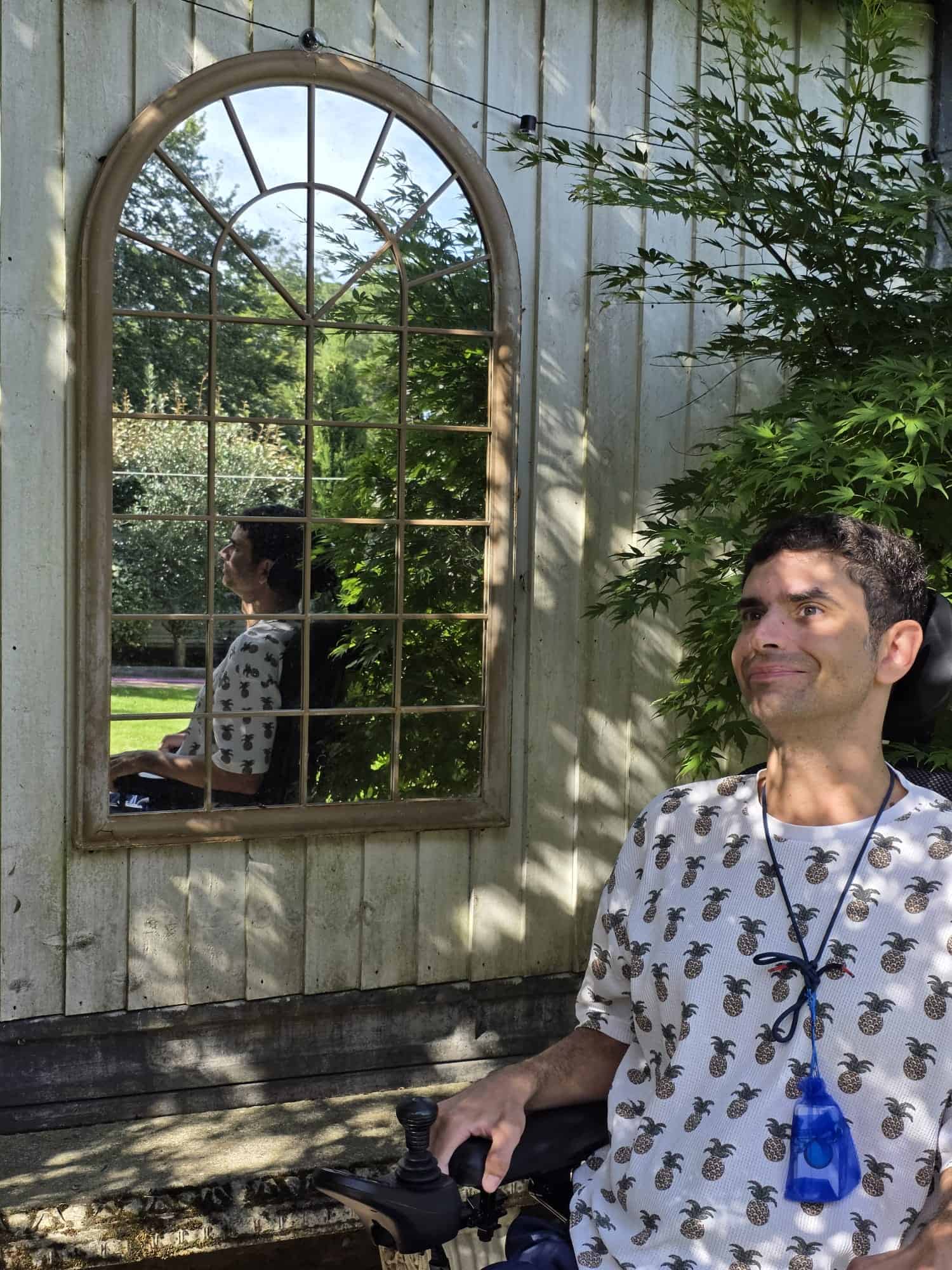
Where I am now – an update for 2026
It is now 10 years and 7 months since my Ataxia began to take me steadily downhill. A lot has changed since I first wrote about my condition. I am now unable to walk and I speak only a little, but I am still here, still smiling and still patiently waiting for a medical cure.
I have learned that even when your body can no longer do the things it once did, there are still things that can make a real difference to everyday life. Movement is key – any movement. When it comes to exercise, I believe that if you don’t use it, you lose it. I try to exercise regularly and keep my brain active too, whether that is learning something, playing chess, drawing, doing brain-teaser board games or even juggling. Swimming is particularly good for me. I can still kind of swim on my back with a life jacket. You may feel a bit silly at first, but you soon get used to it. I also try alternating my limbs each day and even alternating which hand I use for my cutlery when eating. My hobby now is lifting weights. I began doing bicep curls with a full water bottle and then switching arms.
Being out in nature is very important to me. I find it very calming and it makes me happy. Many years ago, a friend of mine who attended Xiamen University in China spoke to a professor of medicine who talked about the different healing qualities of sunlight and the benefits of being outdoors. I have certainly found that simply getting outside, particularly in the morning or evening sunlight, and spending time in a green garden can make a difference to how I feel. Having a lovely carer who can take me out, even just for a day trip, makes a big difference too. I try to get to a Lily Foundation coffee morning every Wednesday if I am awake and able to go. I have also enjoyed foraging in the garden with a carer and a basket, and drawing things from everyday life and whatever I see around me.
I also use a red-light therapy panel, which I feel helps me. I have heard that red-light therapy may help mitochondrial patients and with anti-ageing – perhaps that is why I am looking younger! Bright screens and blue light from the television, mobile phone or computer can be tiring for my brain – something a doctor has also discussed with me. I use blue-light-blocking glasses, made with plain glass rather than prescription lenses, and when my eyes are hurting I have learned to look down and close them for a while.
I try to eat healthy food and remind myself that food is energy. I include beetroot in my diet, something I learned about through the Lily Foundation. As a mitochondrial patient, I also find it better to eat little and often and to drink water regularly. I take Q10 mixed into my food – two doses at breakfast, two at lunch and two at dinner. I enjoy listening to Buddha chants or other healing music and practise regular SOMA deep-breathing techniques, which I find calming and helpful. Getting enough sleep matters too. I try to go to sleep at about 10pm and I feel better when I get up at about 9am, even though I don’t work.
A loving and caring family is perhaps the biggest help of all. There is something very special about sitting in a beautiful green garden and watching young children play. I am very appreciative and grateful to my guardian angels, my family, my friends and everyone who has helped me or shown me kindness along the way.
There are practical things I have learned as well. When transferring, I make sure I am properly positioned next to the bed or sofa to reduce the chance of an accident. If I become hot and flustered, I find that a cold, rinsed flannel on my chest helps me cool down. I also use simple ways to communicate what I need: I point towards where I want to go, and if I need help getting to the toilet I put my hands together and use two fingers to make a T. These may sound like small things, but when you live with a neurological condition, small things can make a big difference.
I have also noticed some improvements. One of the first was being able to turn a light off slowly at the switch. My spine seemed to toughen up and I stopped falling forward at mealtimes. My dexterity and hand movements improved, my focus became sharper and my listening clearer. Most importantly, I felt less tired, so I had more energy. I found I could move my limbs more easily and even regained a little of my balance. From my own experience, I believe the brain can rewire itself. I am no magician, but I think you have to really want to get better, have the right mindset and persevere. I strongly believe in visualisation too. I have also heard that singing and humming can be good for the voice, so I might give that a go.
My Ataxia has changed my life enormously, but it has not taken away my sense of humour or my determination. I still like Harry Potter as much as I did at 12, just 30 years older! Laughter really can be the best medicine. Technology, including AI, is moving so fast that I remain hopeful that a medical treatment or cure for mitochondrial disease will come our way. Until then, I keep moving in whatever way I can, enjoying the people and the world around me, and facing each day with a smile. I try to keep thinking of entrepreneurial ideas and ways I can make a difference. I try to remove negative words from my vocabulary and surround myself with like-minded people. Even when times are tough, I try to keep a smile and be happy. There is always light at the end of the tunnel. Just focus on happiness.